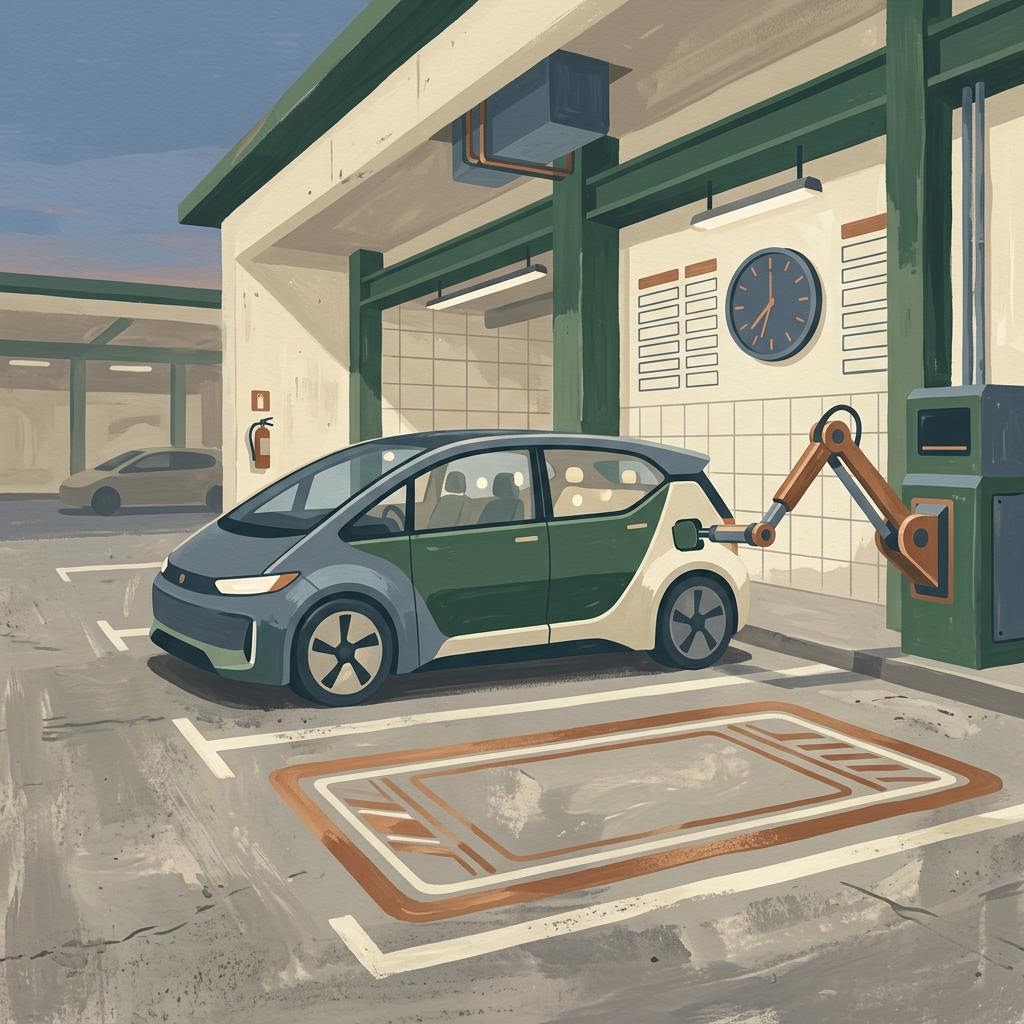
A driverless car has no one to pull the cable off the charger. The site has to do that job. There are four general ways to do it: a robotic arm or connector, a wireless pad in the stall, a wireless lane in the road, or people at a depot who plug cars in. Each one changes what a parking owner has to build.
I run parking lots, and I have filed patent applications on several of these problems. Those filings are pending. What follows is how I think about the site, not a description of any automaker's hardware.
The charge has to fit the next ride
A robotaxi earns money when it carries a rider. Every minute on a charger is a minute it is not earning. So the first question is not how fast the charger is. It is when the car needs to leave.
A dwell scheduler answers that. It looks at the car's state of charge, its next trip and the power the site can deliver, then picks a stall and a charging window. A car with a ride in 20 minutes gets a short top-up near the exit. A car parked for the night gets a slow charge in the back row. The goal is to spread the load and keep each car ready for its next pickup.
My pending filing on an AV dwell and charging scheduler covers that kind of coordination. A related filing covers slot control: which vehicle is allowed to park, load or charge in a given space, and for how long.
Robotic connectors
A robotic connector does what a driver does with a cable. It finds the port, lines up the plug and makes the connection. The hard part is not the motion. It is safety and fault handling. The arm has to know when a person is nearby, when the car moved, and when the plug did not seat.
For a site owner, a robot means a fixed position for each stall, a clear zone around the arm, weather protection and a service plan. It also means a record of each connection attempt, because a fleet will want to know about every failed plug-in. I have a pending application on a robotic EV charging connector.
Wireless pads and lanes
Wireless charging removes the plug. A pad in the stall sends power to a receiver under the car. That needs accurate parking, because alignment matters. Clear stall markings and guidance help a car stop in the right place.
Wireless lanes go further. Coils in the road charge a car while it moves. That is a public-works project, not a parking project, and it is early. I have a pending application on dynamic wireless charging lanes because short, fixed routes such as airport loops and depot entrances look like a natural place to try them.
Depots with people
The simplest answer is a depot with staff. People plug cars in, clean them and check them before the next shift. It works with today's chargers.
The weakness is labor at 3 a.m. and the space a depot needs. The strength is that a person can see a cracked seat or a spilled drink. Before a robotaxi goes back into service, someone or something has to certify it is ready. I have a pending application on fleet service readiness certification for that step.
Power is the real limit
A lot built for parked cars may not have the power for a row of fast chargers. A utility upgrade can take time. Software-defined power routing lets one service feed many stalls and move power to the car that needs it most. Mission-safe vehicle-to-grid lets a parked fleet send power back during peaks, as long as no car drops below what its next ride needs. Roaming lets a car charge on another provider's network when its home depot is full. I have pending applications on each.
What owners can build now
You do not need to know which charging method wins. You need a site that can take any of them.
Start with power. Ask your utility what capacity is available and how long an upgrade would take. Run conduit to more stalls than you need today.
Lay out stalls for repeatable parking. Straight bays, clear markings and room for equipment at the head of each stall help robots, pads and people alike.
Keep records. Log which car used which stall, when it charged and how much. Fleets will want that data, and you will want it when there is a dispute.
Leave room for cleaning and inspection. A robotaxi needs more than power between rides.
Where Wins fits
Wins Parking designs, builds and manages parking and installs EV and robotaxi charging. When an owner asks me what to do about driverless cars, I start with the same three things every time: power, layout and records. Those are worth having whether the first robotaxi arrives next year or later.
The cars will keep changing. The parking lot under them changes slowly. That is why the lot has to be ready first.
Frequently asked questions
Does this describe Tesla's charging hardware?
No. It describes general approaches any fleet or site can use: robotic connectors, wireless pads or lanes, and staffed depots.
What should a parking owner build first for robotaxis?
Power capacity, conduit to extra stalls, straight repeatable bays and a record of which vehicle charged where and when.
Are the charging filings issued patents?
No. The charging, scheduling and readiness filings are pending applications.