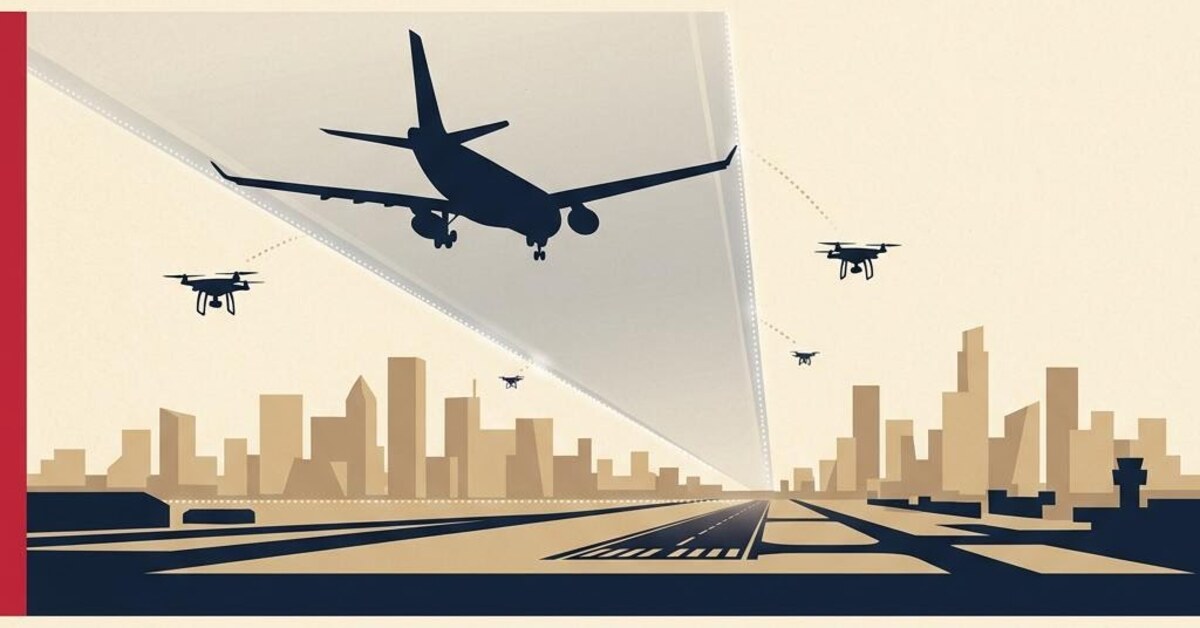
I start with the crewed aircraft's path. A nearby drone needs to move or hold before the two aircraft conflict. The people managing the flight need current information, and reviewers need a record afterward.
My five applications filed April 30, 2026 are patent-pending. They address protected corridors, authenticated drone commands, threat assessment, pilot and controller advisories, and event records.
Start with the crewed aircraft
The dynamic drone safety corridors application proposes four-dimensional protected corridors. They follow specific crewed aircraft along approach and departure procedures. Time is part of the corridor alongside position, because the aircraft moves through different places as the procedure progresses.
The proposed corridor follows the aircraft rather than staying fixed around the airport. Signed commands direct cooperative drones to move or hold. That coordination keeps the response tied to the aircraft at risk.
Compare the drone's movement with the crewed aircraft's changing position. A fixed airport boundary alone cannot express that relationship.
Authenticate commands to enrolled drones
The authenticated drone safe-mode commands application addresses cooperative commands directed to enrolled drones. Authentication is part of the command process. The receiving drone needs to distinguish a trusted instruction from an untrusted message, even when the message concerns an urgent safety situation.
A cooperative drone participates in the command relationship. A non-cooperative drone presents a different problem: it needs to be detected and assessed. I would keep those cases separate when deciding which function addresses the aircraft involved in a conflict.
I would ask who has operating authority and how the proposed activity fits the applicable permissions. Drone coordination near crewed aircraft belongs with the responsible aviation parties. A property owner needs to bring concerns to the appropriate authorities rather than attempt private interference.
The proposal addresses how cooperative aircraft could receive authenticated instructions to move or hold in response to a conflict. I treat trust in the instruction as a separate question from detecting the aircraft. The command recipient needs a basis for accepting the message.
Detect and assess what does not cooperate
The airport drone detection and threat-scoring application addresses detection, classification and threat scoring. Its setting is active airport corridors. It is a separate filing because recognizing and assessing a drone is different from sending it an accepted command.
Detection starts the response. Identify the aircraft, assess its movement against the active corridor and give the responsible people the information they need to act.
I separate three questions within assessment. What has been detected? How is it classified? What threat does it present within the active corridor? Each contributes a different part of understanding the situation before the responsible people decide how to respond.
Keep pilots and controllers informed
My pilot and ATC drone conflict advisories proposal sends real-time conflict information to pilots and air traffic control during cooperative deconfliction. The people handling the crewed flight need that information while the conflict is active.
An advisory and a command are not interchangeable. An advisory informs the people managing a crewed flight or its operating environment. The safe-mode command proposal concerns cooperative, enrolled drones.
Send conflict information to pilots and controllers, and authenticated commands to enrolled drones. Keep the recipients and purpose clear.
An advisory has to reach the people handling the current flight. Aircraft continue moving while the situation is assessed. I focus on that immediate information need rather than treating a record stored for later review as a substitute for informing the pilot and controller.
Record the event for later review
My drone-aircraft near-miss evidence recorder proposal preserves tamper-evident records of near-miss and strike events for regulatory, insurance and dispute review.
I regard evidence as part of the original design problem. A later reviewer needs to understand what information supported the action taken. A conclusion without its supporting record is harder to examine.
Tamper evidence addresses the integrity of a record by making later changes detectable. The observations within it still need assessment. I would examine both the recorded information and its integrity before drawing conclusions about an event or the response to it.
Keep the observations and response together. An insurer or regulator needs to know what happened and what information was available when the response was chosen. Preserve that context instead of retaining only the final conclusion.
Give each function a clear responsibility
The five applications address a moving corridor, authenticated commands, detection and scoring, advisories, and evidence recording. I would assign responsibility for each function in an operating plan. Protecting airspace, communicating a conflict and reviewing it afterward involve different decisions and different information needs.
The corridor concerns the crewed aircraft's path. The command concerns an enrolled drone's trusted instruction. Assessment concerns the detected aircraft and its threat. I keep each decision tied to the aircraft or person it is intended to serve.
Imagine an approach with a cooperative drone nearby. The corridor follows the crewed aircraft, while the command relationship concerns the participating drone. The pilot and controller need advisories about the conflict. Later reviewers need a record of the event.
For each function, I would ask what information it needs and who is responsible for the next decision. A detection needs assessment. A conflict needs communication. A completed event needs evidence for review. Those handoffs deserve attention alongside the individual technical functions.
Establish operating authority before use
Any real use requires the relevant permissions, review and operational coordination. I would resolve authority with the responsible aviation parties before use. Private jamming, seizure or interference with aircraft is outside the cooperative command relationship and must not be undertaken on the basis of these filings.
I would relate protection to the crewed aircraft, address cooperative drones through authenticated commands and assess the rest. Inform pilots and controllers while the conflict is active. Preserve evidence for later review, with clear responsibility for each decision throughout the operation.
Frequently asked questions
Are these five aviation approaches certified systems?
No. I filed these five applications on April 30, 2026. Aviation operations require the relevant permissions, review and coordination with the responsible authorities.
Would a signed command control every drone?
No. The command approach addresses cooperative, enrolled drones. Non-cooperative drones require separate detection, threat assessment and response by the appropriate authorities.
Does a filing authorize a private operator to interfere with aircraft?
No. Private operators must bring drone concerns to the appropriate aviation authorities. Do not jam, seize or interfere with aircraft.