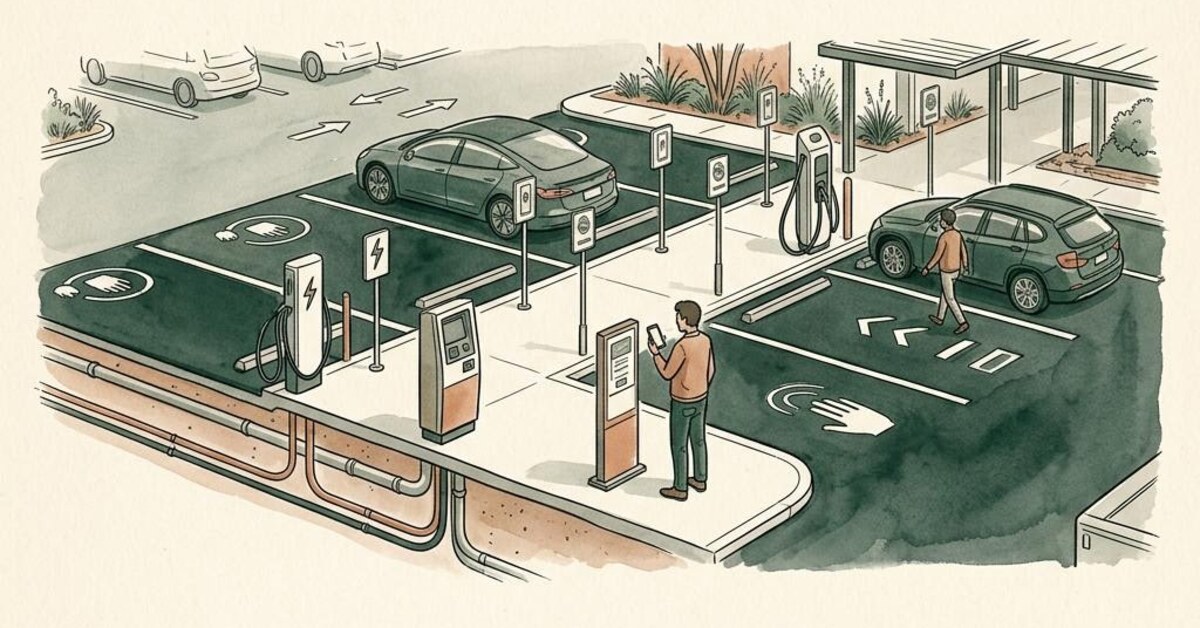
Start with the site you operate today
I would prepare a parking lot for autonomous vehicles without assuming a date for their arrival. Owners still need a site that works for today's customers. Improvements should have a clear operating purpose before they depend on future fleet demand.
I start with power, payments and permission. Confirm the electrical service, make payment clear and define who can use each space. Those decisions help today's customers as well as future fleets.
I would begin with a record of existing conditions and the owner's intended uses. That includes current parking, customer movement and service access. A future charging area must fit the property rather than displace essential work without a plan.
Ask the utility before ordering equipment
High-power charging starts with electrical service, not a charger purchase. I would bring the utility and a qualified electrical design team into the discussion early. They need to assess existing service and the proposed loads.
There is no capacity number that fits every lot. A small site and a fleet charging location have different needs. The appropriate design depends on the equipment, operating plan and service available at that address.
The team should distinguish capacity available now from capacity that requires additional work. The owner needs to know who is responsible for each part. I would not treat an early conversation as a confirmed service commitment.
Work with the utility and design team on the actual property. Permits, utility requirements and professional engineering govern the installation at that address.
Plan conduit before restoring surfaces
I would coordinate electrical routes with the civil work before construction begins. Conduit, equipment locations and vehicle movement need to be considered together. Opening a completed surface again is work an owner should try to avoid through planning.
Ask the design team for an expansion plan with stated assumptions. Place conduit where the planned loads and equipment need it. Leave room for maintenance rather than filling every available area with charging spaces.
Leave crews room to service the equipment without blocking customers.
Put payments in software
Park Graph provides QR and software payments for parking. I see those payments as a practical step an owner can take before autonomous demand becomes a business assumption. The customer needs a clear way to identify the location, see the price and pay.
Some sites need gates for security or access control. Keep the barriers the property needs and use software to manage payments. I evaluate payment rules and physical security separately.
I would require the operator to define what a successful payment authorizes. A receipt should correspond to a location and permitted use. Paying for parking should not be confused with permission to occupy a charging or loading space.
The operator also needs a process for payment problems. A customer should be able to reach someone who can examine the record. Automation does not remove the need for an accountable decision when facts conflict.
Separate pickup, staging and charging
I would designate different spaces for different activities. Pickup needs to support a passenger entering a vehicle. Staging means waiting for an assignment without blocking another use.
Charging adds equipment access and a period of occupancy. A single space cannot serve all three uses at once. The site plan and operating rules must reflect those conflicts.
I would ask who can authorize each use and for what period. The rule should identify the space and the vehicle or operator. A general invitation to enter the property is not a reservation for a particular bay.
My AV parking, loading and charging slot-control proposal uses sensor-verified mission credentials to connect access, dwell and charging with the vehicle's intended work. A pickup needs a suitable bay at the agreed time, not just permission to enter.
Decide what evidence is needed
Enforcement starts with a rule that can be understood and checked. I want the operator to distinguish a payment record from evidence of occupancy. Those records answer different questions.
A disputed notice requires a review process, not just a second copy of the same assertion. The operator should be able to explain the location, time and applicable rule. The customer should have a way to provide conflicting evidence.
My AV digital evidence recorder proposal connects mission credentials, sensor data, property-rule versions and physical outcomes. My private-property air and ground traffic-control proposal coordinates vehicles, drones, robots and pedestrians sharing a facility. These three applications are patent-pending.
I would define retention and access rules for operating records before collecting them. More information is not automatically better. The site should collect what it needs for its stated purpose and handle it under a clear policy.
Design, build and manage as connected work
Wins Parking designs, builds and manages parking nationwide from its Rocky Mountain base. It is family-owned and has operated since 2016. Wins Design & Build is its construction division.
Wins also installs EV and robotaxi charging. I would ask the owner to evaluate the intended demand and any fleet agreement before choosing equipment. The installation needs to fit the actual property, its service capacity and the work expected there.
Give the design team the maintenance and customer-service requirements. Someone must inspect, clean and repair the equipment, and explain payment rules to customers.
I would sequence the work around verified site conditions, service planning, permits and the operating plan. Then I would coordinate construction and payment setup. Commissioning should confirm the installed systems before the owner advertises their availability.
Build a property with documented capacity, clear payments and explicit permission rules. Serve current users first. Add fleet capacity against a specific operating plan and agreement rather than a forecast of when robotaxis will arrive.
Frequently asked questions
How much electrical capacity does every lot need?
There is no universal capacity requirement. A qualified design team and the utility must assess the site, proposed loads and service constraints.
Must every physical gate be removed?
No. Software payments do not eliminate physical security requirements. Keep the access controls the site needs and connect payment and permission rules.
Are the linked autonomous site concepts deployed products?
Slot control, evidence recording and traffic coordination are proposed systems. For a site project, check the installed equipment, access rules and service agreements with the owner before relying on autonomous operation.