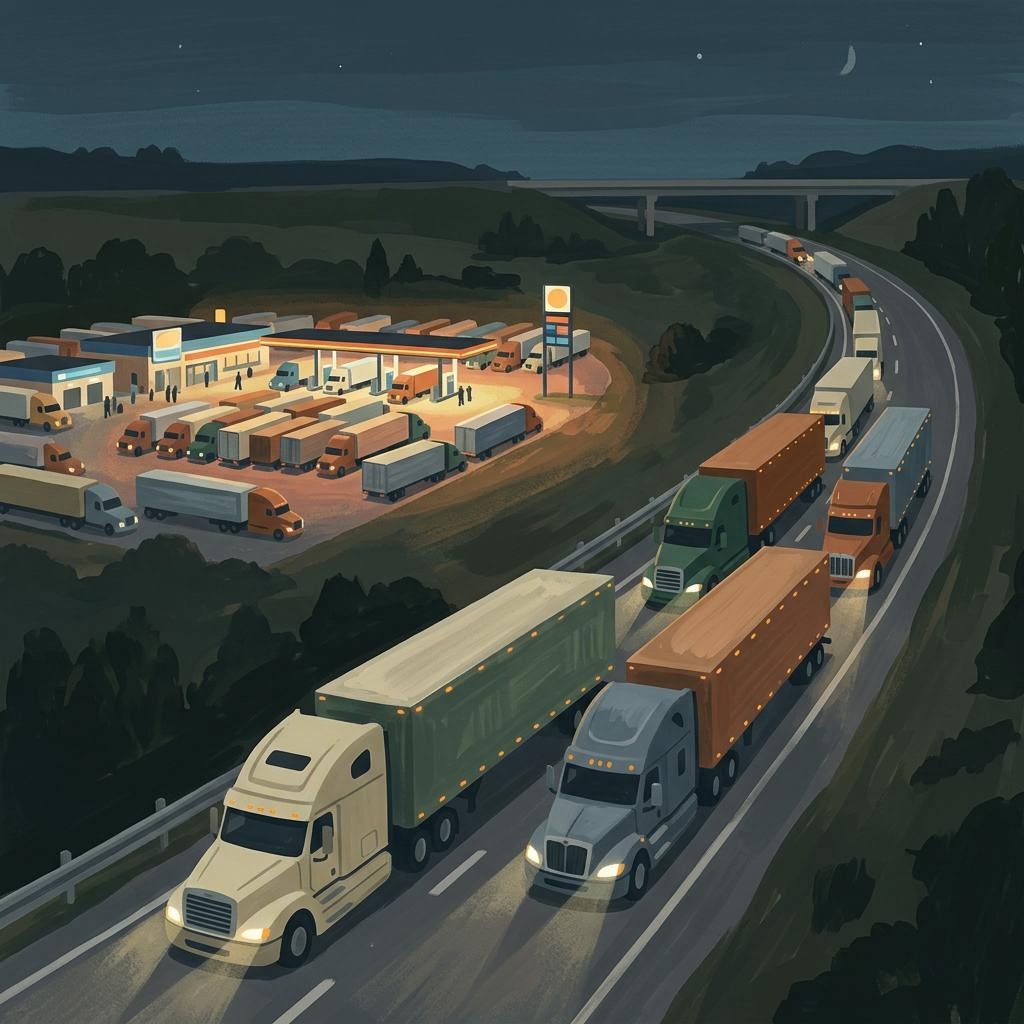
Truck parking is short where drivers need to stop, and most of the spaces are private. FHWA's Jason's Law survey, using 2014 data, counted 308,920 truck parking spaces. Only 11.7% were public. When a lot is full, a driver out of hours may have to choose between an unsafe or illegal spot and driving on.
I design, build and manage parking. Truck parking is the version of the business where a shortage has the most direct safety cost.
Why drivers have to stop
Federal hours-of-service rules limit how long a commercial driver can drive and require rest breaks. A driver has to stop when the clock says so, not when a lot appears. That is the point of the rule: fatigue raises crash risk.
A driver near the end of their hours who finds a full lot has bad options. Park somewhere unsafe or not allowed. Or drive past the limit to find a space. Neither should be a choice.
How short the supply is
I use the 2014 data from FHWA's Jason's Law survey for state-by-state comparison. It found 36,222 public spaces, mostly at rest areas, and 272,698 private spaces, mostly at truck stops.
Some states had far fewer spaces relative to truck traffic than others. Measured as spaces per 100,000 daily truck vehicle-miles, Rhode Island had 31.4, California 53.7, Tennessee 54.2, Delaware 56.1 and Connecticut 60.2. Those were the lowest ratios in the data.
ATRI and AASHTO published state findings with 2024 data. They use different definitions and units, so the two counts should not be compared directly. Park Graph's open dataset lists both, side by side, with that warning.
What it costs drivers
ATRI's 2016 parking diary study, in which drivers recorded their search for parking over two weeks, estimated that the search cost drivers an average of $4,600 a year in lost wages. Time spent hunting for a space is time not driving, and many drivers are paid by the mile.
Why more lots do not get built
Land near interstates and freight hubs is expensive. A building on the same acre can earn more than a truck lot. Neighbors may object to trucks idling at night. Zoning may not allow it.
Truck stops also sell fuel and food. Where nearby parking is free, a parking-only business is hard to finance.
Rest areas are public, and expanding them depends on state budgets.
Parking also depends on timing. Demand is not even through the day, and a lot with room at one hour can be full at another. An owner may see an average. A driver sees the moment they arrive. A count of spaces alone does not show that difference.
What would help
Reservations. A driver who can reserve a space hours ahead can plan the day around it. Some private truck stops already sell reserved spaces. A reserved space is worth more to a driver than a free space that may be gone.
Real-time availability. Some states have tested signs and apps that show open spaces at rest areas. Drivers can then stop at a lot with room instead of pulling into a full one.
Unused land. Industrial outdoor storage yards, closed retail lots and staging areas can hold trucks overnight. With lighting, fencing and a clear access log, they can earn steady income.
Clear rates and records. Drivers and carriers want to know the price before they arrive and want a receipt after. Owners want to know who parked, when and for how long. A dated record also helps when a carrier, a driver and an owner disagree about a stay, a charge or damage to a trailer.
How I would build a truck lot
Start with location: within a few minutes of an interstate exit, with safe turning room in and out. Check the route from the exit to the gate for low bridges, tight corners and weight limits.
Plan circulation. Trucks need wide aisles and pull-through spaces. Backing needs room and attention in any yard. My one issued patent, U.S. 12,741,586, covers a vehicular backup safety system for parking lots, yards and other operating areas.
Add lighting, fencing, cameras and restrooms. Those make a lot safer to use at night.
Sell reservations and keep records. A pending application of mine covers atomic reservations across several lots for a fleet, so a carrier can book spaces along a route at once.
What reporters can check
Use the state table in Park Graph's truck parking dataset to see where your state ranks. Then call a driver who runs your main freight corridor and ask where they stopped last night, and how long it took to find the space. That answer tells the story better than any count.
Wins Parking designs, builds and manages lots like these. The problem is not new. The tools I describe here, reservations, records and better use of existing land, exist today.
Frequently asked questions
How many truck parking spaces are there?
FHWA's Jason's Law survey counted 308,920 spaces using 2014 data; 36,222 were public.
What does the search for parking cost drivers?
ATRI's 2016 parking diary study estimated about $4,600 a year in lost wages per driver.
What would help most?
Reservations, real-time availability, use of underused land such as outdoor storage yards, and clear rates and records.