A location is not a successful charge
I separate finding a station from getting energy into a car. A map can answer the first question without answering the second. That difference matters most when a driver has little charge left.
A station record can have the correct address and still leave out a broken connector. A working connector can be occupied when the driver arrives. A compatible charger can sit behind a closed entrance.
I check the connector, access hours and current network information before choosing a stop. The address gets the driver there. Those details determine whether the car can charge.
Drivers encounter broken chargers
Plug In America's May 2024 survey, The Public Charging Experience, gathered responses online from March 7 through March 28, 2024. There were 923 respondents in the overall survey. Their experiences help explain why drivers need more than a list of station addresses.
In that survey, 68% of respondents said they encountered a broken or nonfunctional charger in the past year. For a driver, finding that problem at arrival creates another decision: try a different connector, seek help or look for another compatible location.
Encountering a broken charger and being unable to charge are different experiences. A driver who moves to a working connector has still encountered a failure. I would examine the individual connector and the options at the site before deciding whether the whole visit is lost.
Among the survey respondents, 92% had access to home charging. Public charging still mattered to their driving experience. I would plan around the actual trip and available options, especially when the driver needs energy away from the place they normally charge.
Choose the speed for the stop
I start with how long the car will remain parked. Level 2 charging uses alternating current and suits longer stays. DC fast charging supplies direct current and serves a different need when the driver needs a shorter charging stop.
Charging speed depends on the vehicle, battery condition, temperature and session. Plan for the car's actual needs and available parking time rather than assuming it will hold the charger's advertised maximum.
For an overnight stay, a useful Level 2 location can be a better fit than a distant fast charger. For a short road stop, the same Level 2 listing can be the wrong choice. Speed filters should help distinguish those uses before a driver leaves the route.
Check the plug and the vehicle
J1772, CCS and NACS are not interchangeable labels. J1772 is associated with AC charging in North America. CCS adds DC fast-charging connections to the combined connector arrangement.
NACS supports AC and DC charging through its connector design. That does not mean every vehicle can use every station with that connector. Access rules and supported adapters still matter.
Check the vehicle manufacturer's compatibility guidance before relying on an adapter. Follow the instructions for both the car and charging equipment.
Check individual ports as well as the station. One site may have several connector types. Count it as one location and confirm which ports the car can use.
Read the date as a record date
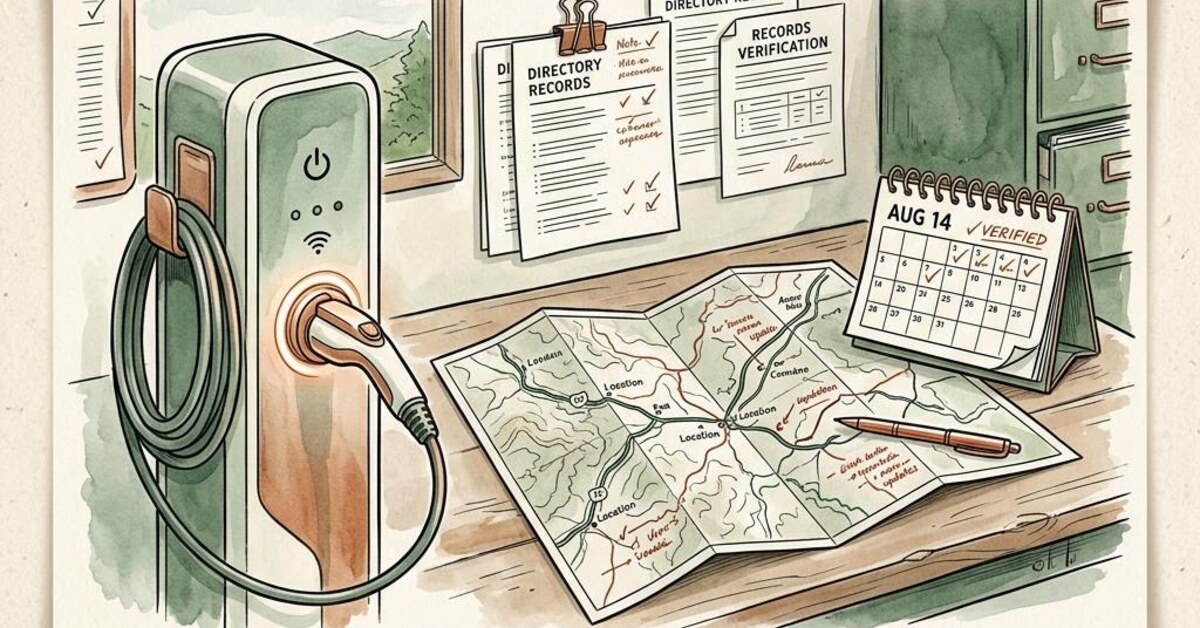
ChargingNear.me lists more than 95,000 stations across all 50 states. Wins Parking, LLC built the directory. Each station page shows when its record was last verified.
I want that date visible because old information should not look identical to recently checked information. The last-verified date shows when the station record was checked. Current connector operation is a separate condition that can change before the driver arrives.
The directory syncs daily from DOE/NREL station data. It is cross-checked against Open Charge Map, Google Places and TomTom. Those checks help maintain station listings. I would also check the network's current information about the connector before relying on it for a stop.
Reimporting a record does not make the underlying observation newer. Check the verification date, not just the import date.
Owners need to close the information gap
I would ask every site owner to assign responsibility for correcting station records. That includes entrances, hours, connector types and restrictions. A driver should not discover a locked gate after following a public listing.
Networks should report faults at the connector level when that information is available. A station-level label can conceal the difference between one failed port and a fully unavailable site. The time of the latest status observation should be visible.
Repair reporting should distinguish an acknowledged problem from a completed repair. I would ask for a record of the problem, the responsible party and the next action. A support number is useful only if someone can act on the report.
Payment instructions also belong in the planning information. Drivers need to know what account or payment method is required. They should not have to discover an avoidable setup requirement while parked at the connector.
Keep discovery separate from access
My pending cross-provider autonomous EV charging roaming application proposes portable signed credentials for participating networks, with settlement records exchanged across provider boundaries. Finding a station and receiving permission to charge remain separate tasks. The access arrangement needs to fit the provider as well as the vehicle.
I would use the directory to compare suitable stops and then check the network's current information. I would also identify another compatible location within reach. Record freshness improves a decision, but it cannot remove every operating failure.
For owners, start with accurate records and prompt repairs. For drivers, check speed, plug, access and the verification date. Choose a second compatible stop before leaving so a broken port does not force a rushed search.
Frequently asked questions
Does the 68% figure describe all EV drivers?
No. It describes respondents to Plug In America’s 2024 survey. The report lists 923 respondents overall and does not publish a separate response count for that question. It does not measure the share of charging attempts that failed.
Does a last-verified date prove a connector works now?
No. It dates verification of the station record. A daily directory sync does not test the connector or guarantee live uptime.
What should I check before choosing a charger?
Check charging speed, connector compatibility, access rules, record freshness and available live network information. Keep another compatible station in reach.