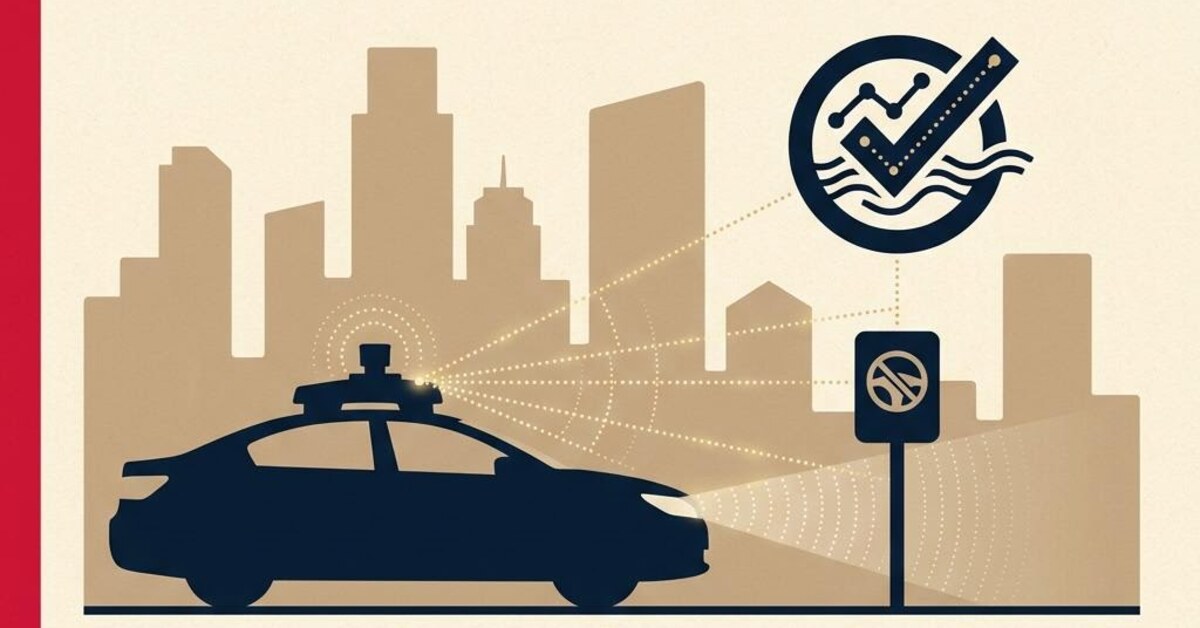
I start with the instruction a vehicle is being asked to follow. Reading a parking sign answers what it says. Trusting it requires a basis for its authority at that location. The action could involve moving, entering a property or sending a payment.
I want the vehicle to check who authorized the instruction and whether it belongs at that location. A convincing sign can still send a car to the wrong space or payment destination.
Readable does not mean authorized
Imagine a parking sign directing a vehicle to a space or a payment destination. The instruction is readable, and the destination looks plausible. I would still ask who placed the instruction there and why the vehicle should act on it at that property.
A changed payment destination makes the risk clear. A vehicle may read the new address correctly and send money to someone who has no right to collect it. Check authority before payment.
What AVIM proposes
AVIM means authenticated visual infrastructure markers. My May 5, 2026 application proposes markers carrying a cryptographically authenticated payload. The vehicle reads, verifies, contextually cross-checks and classifies that payload before acting.
The filing connects those checks to actions such as parking, charging, routing, access and settlement. Verification comes before the action governed by the marker. I focus on the moment when infrastructure information becomes a reason for the vehicle to move or transact.
I would ask what authority the marker is meant to establish. A parking instruction and a payment instruction have different consequences. The operator needs to identify which action depends on the marker and what permission the vehicle needs for that action.
Why context is a separate check
A signature and a location answer different questions. The proposed AVIM approach includes contextual cross-checks because the meaning of an instruction depends on where it is encountered. I want the vehicle's trust decision tied to that context as well as the authenticated payload.
For an owner considering a marker, I would ask which space it represents. I would also ask which action the vehicle is being asked to take. A curb instruction belongs to a particular physical location, and its meaning needs to fit that location.
For example, a curb marker should correspond to that curb. Check the message against the location and permitted use. A valid signature on information for another space should not direct this vehicle into it.
Assign responsibility for each marker's location and purpose. The owner should know which action it authorizes and who maintains it.
The camera and LiDAR proposal
I filed the dual-layer camera and LiDAR marker application on October 20, 2026. It proposes a signed visible code over a retroreflective pattern that LiDAR reads through the ink.
Under the proposed approach, both layers verify under one signature. They must also align on one marker before the vehicle acts on a parking, curb or charging instruction. The camera and LiDAR observations need to agree about the same physical marker.
Imagine the vehicle approaching a charging instruction on that marker. Before acting, it needs the two layers to verify and align. A successful reading of only one layer leaves the combined check unfinished. The physical action waits on the relationship between both.
A real sign still does not reserve a space
Authenticating a marker and granting a right to use a space are separate decisions. A legitimate sign can identify infrastructure without establishing that a particular vehicle has permission to occupy it. I would keep those checks separate in any operating discussion.
My authenticated parking, curb and charging space credentials application addresses that entitlement. It links a physical space, a specific vehicle or mission and a transaction record. The filing includes reservation, authorization, exclusivity, dwell enforcement, conflict resolution and settlement.
ASCAV concerns the space credential, while AVIM concerns the visual infrastructure marker. I keep those roles separate. A marker carries trusted information at the property; the space credential connects operational entitlement with a particular space, vehicle or mission and transaction.
Together, the concepts ask two different questions. Is this infrastructure instruction authentic? Does this vehicle have the right to act on it here?
What an owner should ask
I would begin with the decision the property needs to support. Parking, charging and payment should not be treated as one permission merely because they occur during the same stop. Each action needs a clear operating meaning.
I would then examine the site's sign maintenance and dispute review. Who is responsible for the physical signs? Who can answer a question about an instruction? Those operating responsibilities remain important as an owner evaluates authenticated payloads or dual-layer markers.
I would also ask what happens when a check cannot be completed. The answer needs to come from an evaluated operating policy. The owner and vehicle operator should resolve that policy before relying on the instruction for movement, access or payment.
Put those decisions in the operating plan. Name the person responsible for sign maintenance and the person who can resolve an access problem. Agree on what the vehicle should do when verification fails.
Keep the operating decisions separate
My marker and space-credential applications are patent-pending.
Check authenticity and entitlement at the same stop. A real marker can direct the car toward a space already reserved for someone else.
I want infrastructure instructions to carry more than a readable appearance. The proposed marker checks address authenticity and context. The proposed space credentials address entitlement. Together, those questions connect what a vehicle reads with the action it has authority to take at the property.
Frequently asked questions
Does this article claim every self-driving car lacks sign checks?
No. Sign recognition and sign authentication are different tasks. I want a vehicle to verify who authorized an instruction and whether it belongs at that location before acting.
What is proposed in the dual-layer marker filing?
The October 20, 2026 application combines a signed visible code with a retroreflective pattern read by LiDAR through the ink. Both layers must verify under one signature and align on one marker before the vehicle acts.
Is authenticating a sign the same as reserving its space?
No. Marker authenticity and the right to occupy a space are different checks. The space-credential application addresses entitlement tied to a space, vehicle or mission and transaction record.