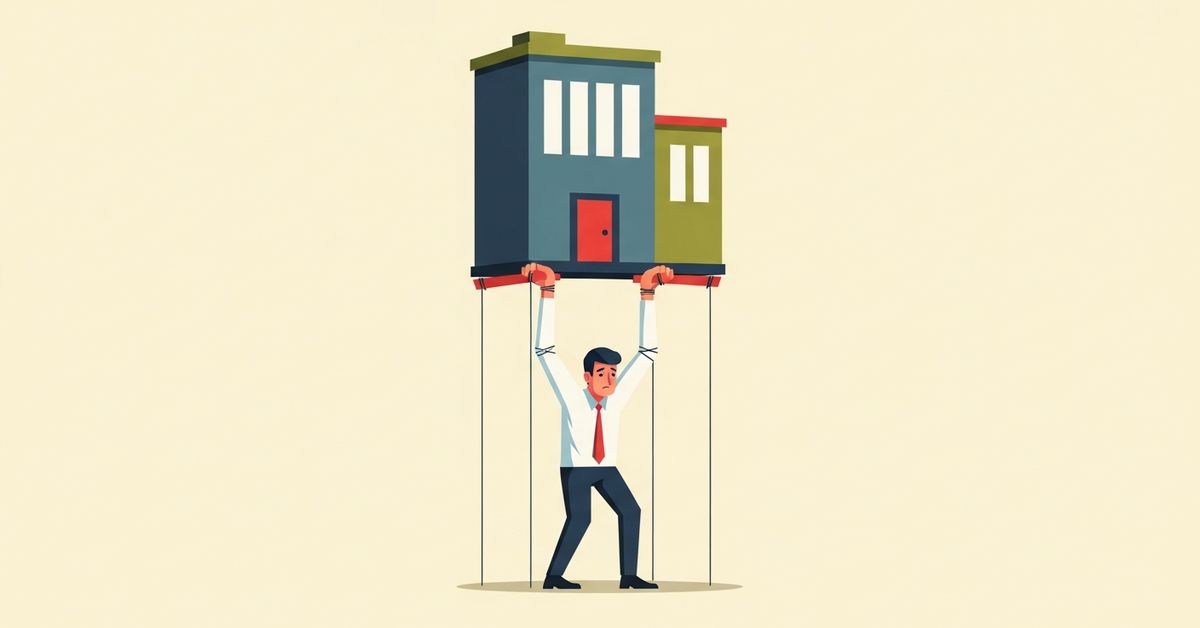
Every owner-led business carries a hidden levy. You will not find it on the P&L, but a buyer prices it the moment they look closely, and you feel it every time you try to take a real vacation. I call it the owner-dependence tax: the amount of value your company loses simply because it depends on you.
Why buyers charge it
A buyer is not purchasing last year's profit. They are purchasing the probability of next year's profit continuing without the current owner. If the founder is the top salesperson, the head of operations, the relationship that every key customer trusts, and the only person who knows why things are done a certain way, then the buyer is not acquiring a business — they are acquiring a job that happens to come with goodwill that walks out the door at closing. They price that risk in, and they price it in hard.
This is why two businesses with identical earnings can sell for wildly different amounts. The one that runs on documented systems, a capable second layer of management, and recurring revenue commands a premium. The one that runs on the founder's heroics gets a discount, an earn-out, and a multi-year handcuff to keep the seller around.
How to measure your own exposure
You do not need an appraiser to estimate the tax. Run an honest audit against four questions:
- Decisions. What percentage of consequential decisions in a week require your input? If it is most of them, you are the bottleneck and the risk.
- Relationships. How many top customers or suppliers would feel a downgrade if you stopped being the point of contact? Those relationships are not the company's; they are yours.
- Knowledge. How much of "how we do things" is written down versus carried in your head? Undocumented process is unsellable process.
- Time. Could you disappear for 30 days with no contact and return to a business that grew, held steady, or fell apart? The honest answer is your score.
The more "you" each answer contains, the higher the tax. And the punchline most owners miss: you are paying this tax today, in stress, in capped growth, and in a business that owns you rather than the reverse.
How to design it out
In Automate, Launch, Retire, I treat owner-dependence not as a personality flaw but as an engineering problem with a known solution: replace yourself, one function at a time, with systems. The sequence matters.
- Document before you delegate. Turn the process in your head into a written, repeatable procedure. You cannot hand off what you have never described.
- Automate the repeatable. Anything rule-based — scheduling, follow-ups, reporting, reconciliation — should run on software, not on your attention. This is where AI now removes work that used to require a hire.
- Delegate the judgment. Build a second layer of people who own outcomes, not just tasks, and let them make decisions inside clear bounds.
- Institutionalize the relationships. Move key accounts onto the company's systems and team so trust attaches to the business, not to your phone number.
Each step you complete buys back a piece of your multiple. A business that can demonstrably run for a quarter without its founder is not just more sellable — it is more valuable to own, easier to finance, and far less stressful to operate.
The takeaway for owners
Stop thinking of yourself as the engine and start thinking of yourself as the architect. The goal is a business whose value lives in its systems, its team, and its recurring revenue — not in your willingness to keep showing up. Pay down the owner-dependence tax deliberately, and you get two things at once: a calmer life now, and a far larger number when you finally decide to walk away.