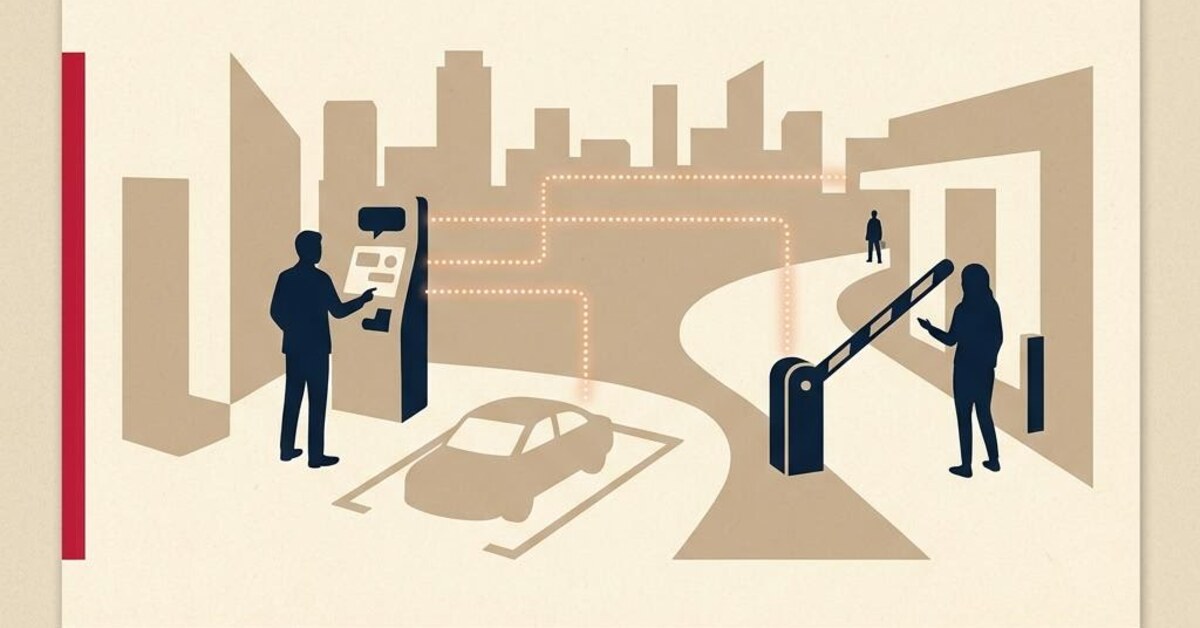
I separate booking a space from using it. A software assistant can arrange a reservation while the vehicle is still elsewhere. Arrival creates additional questions about permission, physical access and who resolves a failure.
Park Graph supports AI-assisted discovery, pricing and booking. A driver can ask an assistant to find a lot, check its price and book. My offline access and authenticated space-credential applications address the separate question of authority at the physical property.
Start with the actual request
Consider this example: “parking near Eagle airport tonight 8pm to midnight, EV”. Before booking, I would want the assistant to resolve the place, date and service. The driver needs to know whether the request is for parking alone or for a charge as well.
I would ask whether “EV” means parking an electric car or obtaining a charging session. Those are not the same service. I would also confirm the date intended by “tonight” and the location meant by “Eagle airport”.
Confirm those details before paying. I want the customer to approve a specific service at a stated price, not discover at arrival that the assistant booked parking without charging.
Three ways to reach Park Graph
Park Graph provides a hosted MCP server, a public REST API and ChatGPT Actions. Assistants such as Claude and ChatGPT can find lots, see prices and book. The customer can reach the parking inventory through those software interfaces.
MCP means Model Context Protocol. It is an interface through which an assistant can use Park Graph's booking capabilities. I would still ask the customer to make the intended place, time and service clear before authorizing the assistant to book.
Tell the customer whether the assistant completed a search, a hold or a reservation. Then state what remains before arrival. I want a confirmation the customer can act on.
A hold is not physical access
Holding a space and entering a property are separate steps. At arrival, the operator needs to recognize the vehicle's right to use the space. I would make that process clear before the customer sets off for the property.
Park Graph's ordinary parking offer is gateless. Drivers use a printed sign rather than gate hardware. At a property that does have a controlled entrance, the operator also needs an access process that connects the reservation to permission to enter.
I would ask a property owner to explain the arrival process independently of the booking screen. What should the driver or vehicle do at the entrance? Who should be contacted when that process fails?
At a gateless lot, check the location and permitted stay against the reservation. An open space may belong to another customer for that period. The operator needs a clear way to resolve a conflict.
What offline access would need to establish
I filed my agent-mediated reservation and offline physical access application on April 28, 2026. The proposed system connects an agent's reservation to physical access through verifiable credentials and offline-capable controllers.
A booking service can confirm a reservation while the entrance controller has no connection. The controller must still check the arriving vehicle's authority. I want the access decision to work from a verifiable permission, not a driver's claim that payment went through.
Define which right the controller checks and what happens when verification fails.
I would want those answers before discussing convenience. Uncertainty at an entrance should not be hidden by a successful booking message. The access policy needs to explain how a person can obtain help without pretending that an unverified credential is enough.
Tie permission to a place and a mission
My authenticated parking, curb and charging space credentials application addresses entitlement to a designated space. It binds that entitlement to a physical space, a vehicle or mission and a transaction record. Its scope includes reservation, authorization, exclusivity, dwell enforcement, conflict resolution and settlement.
That proposed approach addresses more than a generic payment confirmation. It asks what right was granted and where it applies. I regard that distinction as essential when software acts across multiple physical properties.
Both access and space-credential applications are patent-pending. Ask each operator how permission is checked at arrival and who can resolve a rejected credential.
Name who is responsible
I use the agent-of-record framework to discuss accountability for autonomous actions. A named human or entity should be responsible for what the assistant is authorized to do. Calling the action automated does not answer who handles the consequences.
When an AI agent makes a mistake, I would start with who authorized the booking and who operates the site. Those roles should be identifiable before a dispute arises. The customer needs someone who can address the reservation and its terms.
Liability depends on the facts and applicable terms. Before the assistant acts, identify who approved the request, which terms apply and who handles an exception. Keep that information with the reservation.
What owners can do now
An owner can begin by making rates, availability and arrival instructions understandable. Park Graph lets owners set rates and see payments on a live dashboard. Its AI booking interfaces extend how assistants can reach the inventory.
I would then test the explanation given to the customer. Does it distinguish parking from charging? Does it say what is reserved and how arrival works?
Finally, I would name the person responsible for exceptions. A customer should not be left between an assistant and an operator when a reservation is questioned. Booking is useful when the right to use the property is clear at the moment it matters.
Frequently asked questions
Which interfaces does Park Graph support for AI booking?
Park Graph supports a hosted MCP server, a public REST API and ChatGPT Actions. Assistants can find lots, check prices and book through these supported interfaces.
Is the Eagle airport request a real booking?
No. Before booking, confirm the date, location, price and whether the driver needs parking or charging. Then check availability and authorize the reservation.
Does a booking prove offline gate access is deployed?
No. Check the property's arrival instructions and access equipment before traveling. An online reservation and an offline entrance controller perform different jobs.